The tension between skill and authenticity in church worship can often be a heated topic but Kauflin addresses this difficult issue head on and nails it.
"Churches that minimize the need for skill can tend toward sentimentalism, sloth, and pride in 'genuineness'" but at the same time, "All the musical skill in the world won't substitute for a genuine heart of worship." (p. 195)
There must be a balance between these two issues. If we want to honor God by leading His church in worship, then we need to have the ability and skill set to do that. If we don't, it will be very difficult for us to point people to our awesome God because they will only be focused on our own inability and lack-of-awesomeness. Also, if we expect to lead His church in worship, then we had better have a genuine relationship with Him that is alive and active each day or we will only be a shell that's making noise and directing people to our own talent.
However, if we pursue either skill or genuineness (which is often mis-understood to be simple emotionality) or even both as an end in themselves, we will still come up empty. The point is not to be better at this or that, "The point is, I do everything to magnify the greatness of God in Jesus Christ. That's worship." (p. 197) This definitely includes being skillful and being genuine, but do you see how the focus has shifted? It is no longer about me and what I have done or what I can do or can't do, instead it is about "magnifying the greatness of God in Jesus Christ." Instead of just saying "I want to pursue excellence in my skills and abilities" or "I want to focus on being more genuine." we should be saying, "I want to be the very best I can be [in both my skill and in my relationship with God] so that I can serve others more effectively For God's glory." (p. 196)
As a worship team, as we play our instruments and sing with our voices
what is it that we want? Is everything we do with a desire of "wanting people to see and celebrate the supreme worth of God[?] [Because] that's leading worship. If that's not why [we're] doing those things, [we weren't] worshiping God to begin with." (p. 197)
I like the phrase, "It's not about me, it's not about now" and I would add to it, "it is about God and it is about His eternity". This makes me ask, "Since life is about God and His eternity, what can I be doing in my life as a worship leader (as a dad, as a husband, as a friend) that will help me to magnify the greatness of God in Jesus Christ?" I hope that this makes you ask this question for yourself and perhaps even make it a part of your prayer time. What can you be doing in your life as a ______________ (fill in the blank with whatever roles God has placed you in) that will help you to magnify the greatness of God in Jesus Christ?

Monday, February 27, 2012

Monday, February 20, 2012
Chapter 24 - Rooted and Relevant
Too often today I hear people talk on one side of the issue or the other. They either can't stand the old hymns and traditions of the church or they can't stand the new music, style, technology, and new traditions of the church. Kauflin gives us a refreshing look at both. He reminds us that we aren't, "the first to think about and pursue Biblical worship." (p. 189) and that our own culture, time, and generation doesn't have a corner on the market for worship.
We, as Christians, come from a long line of strong Christian men and women throughout the ages and those men and women had the same Spirit of God in them that we have today. God spoke to those men and women and they had lots of valuable ideas and insights into Biblical Christian living and worship if we are willing to look into their traditions and see them. However, "The greatest traditions in the world are meaningless unless they effectively communicate God's truth to the people who come to our meetings." (p. 191) Wonderful, theology-rich traditions are pointless if people don't understand them. It is important that, if we are drawing upon those traditions, people clearly understand the meaning behind them. There is value to be found in the hymns and traditions of the church past. There is also value in being fresh and new and giving people ways to see and hear the gospel in ways that they have not before. "Being the church is no reason to be thirty years behind in decorating styles, graphics, and technology...our goal is to communicate clearly..." (p. 192) Both the old and the new can be wonderful tools for bringing people to a greater understanding of God and who He is. But the point is that no matter what we draw upon, whether it is Old or New, that the focus is not upon the tool of communication, but rather the focus is on the purpose of the communication...the Gospel of Jesus Christ! "..every church should make sure that the story of God's redemption can be clearly understood and experienced by those they're seeking to reach with the Gospel." (p. 192)
"When it comes to forms of worship, any form that facilitates and encourages worship in spirit and truth by a particular gathering of people, at a particular time in history, in the context of a particular culture is pleasing to God...Cultures change, styles change, traditions change, times change. God remains the same." (p. 193)
We, as Christians, come from a long line of strong Christian men and women throughout the ages and those men and women had the same Spirit of God in them that we have today. God spoke to those men and women and they had lots of valuable ideas and insights into Biblical Christian living and worship if we are willing to look into their traditions and see them. However, "The greatest traditions in the world are meaningless unless they effectively communicate God's truth to the people who come to our meetings." (p. 191) Wonderful, theology-rich traditions are pointless if people don't understand them. It is important that, if we are drawing upon those traditions, people clearly understand the meaning behind them. There is value to be found in the hymns and traditions of the church past. There is also value in being fresh and new and giving people ways to see and hear the gospel in ways that they have not before. "Being the church is no reason to be thirty years behind in decorating styles, graphics, and technology...our goal is to communicate clearly..." (p. 192) Both the old and the new can be wonderful tools for bringing people to a greater understanding of God and who He is. But the point is that no matter what we draw upon, whether it is Old or New, that the focus is not upon the tool of communication, but rather the focus is on the purpose of the communication...the Gospel of Jesus Christ! "..every church should make sure that the story of God's redemption can be clearly understood and experienced by those they're seeking to reach with the Gospel." (p. 192)
"When it comes to forms of worship, any form that facilitates and encourages worship in spirit and truth by a particular gathering of people, at a particular time in history, in the context of a particular culture is pleasing to God...Cultures change, styles change, traditions change, times change. God remains the same." (p. 193)
Monday, February 13, 2012
Chapter 23 - Planned and Spontaneous
In this chapter Kauflin presents a great contrast of using both the planned and the spontaneous during worship to follow the Spirit's leading. There are many Christians who reside in the camp of "If you've planned it and it's not spontaneous, then it's not from the Spirit." But this is simply a bogus notion. God is a planning God. He planned the universe through from it's beginning (creation), to it's redemption, (Jesus' birth, death, and resurrection), to it's conclusion (new heaven, new earth, and the bride of Christ (the Church) finally is united with Him), and on through eternity. Saying that the Spirit must be spontaneous is like saying "The Spirit can't possibly plan ahead." I for one have no intention of saying that the Spirit of God is limited in what He can do. "We've found that the Holy Spirit's most important guidance often comes before the meeting even begins." (p. 182)
On the flip side, though, God has, and can certainly speak in the moment as well. "Planning doesn't substitute for listening to the Holy Spirit during the meeting either." (p. 182) This last weekend was a good example of how and why God might choose to speak in the moment. If you weren't there this weekend I shared a short testimony of what God had been doing in my life and challenged people to actively pay attention to the Holy Spirit (and yes, I did cry in first service). This is something that I couldn't have planned ahead of time because it wasn't until during the sermon that I made the connection between my experience and what Jim was saying. And if I had tried to plan it all out and had a rehearsed speech to say, it wouldn't have had the same impact as it did in the moment. I know for certain that the Holy Spirit was moving in me to share at the end of first service. However, I'm still not sure if God intended for me to say it again at the end of 2nd service, but being unsure I decided to go ahead anyway. I'd rather mess up trying to follow what I thought was God's leading rather than do things smoothly while ignoring Him.
"Spontaneity gives us the freedom to respond to present needs and promptings." (p. 185) "...the Spirit can also use us in powerful ways as we play notes we've practiced for hours during months of rehearsals. But isn't it helpful to be able to do both?"
I think I (and we as a team) weigh more heavily on the planning side of the scale. I like Kauflin's idea of "practicing spontaneity". Being capable and able to readily respond to the Spirit at a moment's notice might take practice but it could help balance the scale.
On the flip side, though, God has, and can certainly speak in the moment as well. "Planning doesn't substitute for listening to the Holy Spirit during the meeting either." (p. 182) This last weekend was a good example of how and why God might choose to speak in the moment. If you weren't there this weekend I shared a short testimony of what God had been doing in my life and challenged people to actively pay attention to the Holy Spirit (and yes, I did cry in first service). This is something that I couldn't have planned ahead of time because it wasn't until during the sermon that I made the connection between my experience and what Jim was saying. And if I had tried to plan it all out and had a rehearsed speech to say, it wouldn't have had the same impact as it did in the moment. I know for certain that the Holy Spirit was moving in me to share at the end of first service. However, I'm still not sure if God intended for me to say it again at the end of 2nd service, but being unsure I decided to go ahead anyway. I'd rather mess up trying to follow what I thought was God's leading rather than do things smoothly while ignoring Him.
"Spontaneity gives us the freedom to respond to present needs and promptings." (p. 185) "...the Spirit can also use us in powerful ways as we play notes we've practiced for hours during months of rehearsals. But isn't it helpful to be able to do both?"
I think I (and we as a team) weigh more heavily on the planning side of the scale. I like Kauflin's idea of "practicing spontaneity". Being capable and able to readily respond to the Spirit at a moment's notice might take practice but it could help balance the scale.
Tuesday, January 24, 2012
Chapter 22 - Vertical And Horizontal
"One of the primary ways we worship God is through proclaiming His glories, perfections, and works. But another equally significant way we worship God is through building one another up through encouragement and blessing. Different activities, but the same end." (p. 178)
There are times in church services that I forget that God has called us to "Speak to one another with Psalms, hymns, and spiritual songs." (Ephesians 5:19a). We get so caught up in the vertical plane (our relationship with God) that we forget to move in the horizontal plane (our relationship with those around us). God is honored when we encourage each other. We worship Him when we show love for, pray for, and serve each other. When we come together to worship by singing praises, taking communion, and learning from Scripture we aren't supposed to be a bunch of separate individuals who are looking only for a one on one experience with God. Individual experience is involved, but we are to be His body with all the different parts working together to bring Him glory (1 Corinthians 12). If the body is thirsty doesn't the hand bring water to the mouth? If the body needs to move won't the legs move the body where it needs to go? The body of Christ is meant to function as a single unit that all works together for the Glory of God.
The next time we come together as the body of Christ, as we participate in our vertical relationship, let's also try to keep our eyes open to the ways that God might want us to participate in our horizontal relationships. Let's look for ways to encourage, pray for, and serve one another and in doing so worship and bring glory to God.
There are times in church services that I forget that God has called us to "Speak to one another with Psalms, hymns, and spiritual songs." (Ephesians 5:19a). We get so caught up in the vertical plane (our relationship with God) that we forget to move in the horizontal plane (our relationship with those around us). God is honored when we encourage each other. We worship Him when we show love for, pray for, and serve each other. When we come together to worship by singing praises, taking communion, and learning from Scripture we aren't supposed to be a bunch of separate individuals who are looking only for a one on one experience with God. Individual experience is involved, but we are to be His body with all the different parts working together to bring Him glory (1 Corinthians 12). If the body is thirsty doesn't the hand bring water to the mouth? If the body needs to move won't the legs move the body where it needs to go? The body of Christ is meant to function as a single unit that all works together for the Glory of God.
The next time we come together as the body of Christ, as we participate in our vertical relationship, let's also try to keep our eyes open to the ways that God might want us to participate in our horizontal relationships. Let's look for ways to encourage, pray for, and serve one another and in doing so worship and bring glory to God.
Monday, January 16, 2012
Chapter 21 - Internal And External

It is important that we recognize first, though, that any form of worship (physically expressive or not) must be based in a accurate view of God. If our worship is based only on what we feel, or on our awareness of our image and reputation, then it is not God that we are worshiping, instead it is ourselves and our emotions or are pride that we begin to worship. "God-pleasing worship involves a heart engagement and an active faith in the existence and goodness of God (Hebrews 11:6) (p. 169)" God looks at our heart as we worship Him. This might lead some to conclude that it is really only what is in someone's heart that matters, but Kauflin points out the error in this way of thinking. I liked how he expressed this in the example with his wife. "If I told my wife, Julie, that I loved her, but never looked glad to see her, never hugged her, and never demonstrated my affection in any concrete way, she wouldn't be too impressed. We wouldn't have much of a marriage either." (p.170) Love that is never outwardly expressed isn't really love at all. True love chooses to act for the benefit of the one being loved without regard to self. Is it important what is in our hearts? Of course, it is absolutely vital, but that doesn't excuse us from the expressions of worship that are modeled for us in the Bible like "...clapping, singing, bowing, kneeling, lifting hands, shouting, playing instruments, dancing, and standing in awe." (p.171) and these can only be meaningful to God if our actions each day demonstrate our love for Him.
Kauflin made two other points that I think are vital to the discussion of physical expression in worship.
- First he says, "These expressions don't all have to be evidenced every time we gather...The crucial question is this: Is there any physical expression of worship that God has given us in Scripture that I've never displayed? And if so, why?" (p. 171) When we lead people in worship, we don't need to feel bad or feel like something is wrong if we don't see a ton of physical expression from the people we are leading every single time. As people go through different things in life their outward expressions (or lack thereof) will change from week to week. Something that might give us cause to pause and think, however, is if there is never any physical expression amidst the people we are leading or if there are Biblical expressions of worship that have never taken place in our church. This should probably make us stop and think, "Are we teaching and modeling a Biblical view of worship to the congregation?" "People in your church will learn the most from what is modeled by you and the other leaders. Churches rarely rise above the level of their leaders in expressiveness and genuine engagement." (p. 173)
- Second he points out that, "Our highest priority when we gather with the church is not our own personal expressiveness but the privilege of serving others. (1 Corinthians 14:12, 13:1-8). Individuals should be following your example and direction in the area of expressiveness, not breaking into loud shouting and enthusiastic dancing just because they feel like it. We're to be concerned about "the interests of others" (Philippians 2:4). At the same time, more reserved members shouldn't assume that expressive individuals are hypocritical, seeking attention, or rude. They might want to consider what they can learn from the unhindered and sincere expressiveness they see." (p. 172) As we lead (and even as we participate as a member of the congregation) we should be aware of the atmosphere and people around us and allow ourselves to be physically expressive in a way that honors God and that isn't going to be a major distraction to the rest of the congregation.
Monday, January 9, 2012
Chapter 20 - Head and Heart
 "...churches can have a hard time connecting the knowledge of the mind with the passions of the heart. Yet they're integrally related. And both are crucial to Biblical worship." (p. 165)
Kauflin has touched on this subject multiple times already, but it definitely is worth being repeated because it is so important. We must not get into the habit of promoting one area over the other. Without accurate knowledge of the truth in the Bible our passion is meaningless and possibly idolatrous. Without passion, the most wonderful and fantastic truth's about God are left uncelebrated and we risk becoming a "religion" rather than being a people who have a marvelous relationship with the living God of the universe.
"The affections we're seeking to stir up are more than fleeting shallow, self-induced emotions. We aren't trying to excite people for the sake of excitement. We aren't leading a pep rally for band. Godly affections are deep and long-lasting. They're the result of focusing on what God has done and who He is." (p. 166)
As a worship team we can move peoples emotions simply by what we play and how we play it. But, as Kauflin said, we aren't just trying to get people emotional for the sake of being emotional. We must be careful to base whatever we are doing in the truth of God's word. Then God's truth is the basis for the emotions that come up within people and it can lead to real change in people's lives and help them to have a deeper relationship with Jesus Christ. We use music to help people along the way and to help lead them to the place where they see God's truth clearly. Our music is a tool to be used to point people to God's truth and to bring honor and glory to God. Music is not the end in itself.
"When the church gathers, the sense of confidant joy in God should be pronounced. When we fail to demonstrate delight and satisfaction in God, we're not only dishonoring God, we're disobeying Him (Psalms 32:11). More than anyone else on earth, Christians have a reason to celebrate." (p. 167)
These words jumped off the page and slapped me in the face. I know that God wants us to be joyful and celebrate in His Name, but I had never thought of it as being sinful to do otherwise. But I think that Kauflin is right. As Christians, no matter what has occurred or is occurring in our lives, we have reason to demonstrate delight and satisfaction in God. I don't think that this means we can't ever feel sad or troubled (Jesus felt sadness and wept on multiple occasions) But even amidst sadness we, as Christians, always have reason for hope and joy. Even amidst difficult times and trials we can still demonstrate our delight and satisfaction in God. Not that this is easy by any means. It takes consistent effort and time spent in developing our relationship with God. It takes a purposeful decision to choose God's hope and joy rather than the world's despair.
There is a woman in our church who has exemplified this better than anyone else I've ever known. No matter what is happening she is always exuding the joy that is found only in God. A while back her husband's health took a turn for the worse and slowly declined further and further over time until finally he passed away. She certainly felt sadness during this time, but never once could any one question her joy in God. She continued to demonstrate her delight and satisfaction in God all through this difficult time in her life. She could do this because her hope and joy was based in her relationship with God and the hope he had given her of her eternal future with Him. That is what we must take hold of and proudly claim as our own. If we can take hold of that relationship and that hope, then we too can demonstrate delight and satisfaction in God no matter our circumstances.
Wednesday, November 30, 2011
Chapter 19 - Transcendant And Imminent
I've been quite busy this week and probably will be for the next few weeks as one of my classes is wrapping up and a number of other things have come up, so I asked Sam and Madeline if they would write the blog for this weeks thoughts on chapter 19. I'm sure you'll enjoy a break from my ranting and a fresh perspective on Kauflin's writing.
-David
Both characteristics of God, His Transcendence and His Imminence, seem like attributes that are emphasized at different times in Christian Church History. It does seem like they are opposing swings on a Master Pendulum. For awhile, perhaps many hundreds of years, the Reverence and Honor due to our Most Holy God was predominant in the Liturgy and Worship in many formal churches. People dressed in their very best attire to go and worship God. Many of our beloved Hymns were written in this period of solemnity and quiet awe.
Currently, though, many of the churches of today strive to be “seeker-friendly”, and thus present God more as a friend and brother and compassionate lover of our souls. We dress more casually, behave more informally, and strive to be very welcoming, just as we remember that Jesus lived among human beings, touching them, crying with them, eating with them. This is a beautiful picture of Him, too.
As Kauflin states on p. 162, “At Calvary we stand in awe of perfect righteousness, holy justice, and unerring judgment. We can offer no excuses or justification for our sin. We’re completely at the mercy of our sovereign Creator and King. Yet the gospel assures us that our sins have been completely atoned for. We’re no longer God’s enemies. We’re His adopted children.” This is a wonderful description of the tension, or the balance, between God’s transcendence and His imminence.
It is especially important to appreciate both of these attributes of God. We do ourselves, and His Church, a disservice if we over-emphasize one, to the exclusion of the other.
-Sam and Madeline
-David
Both characteristics of God, His Transcendence and His Imminence, seem like attributes that are emphasized at different times in Christian Church History. It does seem like they are opposing swings on a Master Pendulum. For awhile, perhaps many hundreds of years, the Reverence and Honor due to our Most Holy God was predominant in the Liturgy and Worship in many formal churches. People dressed in their very best attire to go and worship God. Many of our beloved Hymns were written in this period of solemnity and quiet awe.
Currently, though, many of the churches of today strive to be “seeker-friendly”, and thus present God more as a friend and brother and compassionate lover of our souls. We dress more casually, behave more informally, and strive to be very welcoming, just as we remember that Jesus lived among human beings, touching them, crying with them, eating with them. This is a beautiful picture of Him, too.
As Kauflin states on p. 162, “At Calvary we stand in awe of perfect righteousness, holy justice, and unerring judgment. We can offer no excuses or justification for our sin. We’re completely at the mercy of our sovereign Creator and King. Yet the gospel assures us that our sins have been completely atoned for. We’re no longer God’s enemies. We’re His adopted children.” This is a wonderful description of the tension, or the balance, between God’s transcendence and His imminence.
It is especially important to appreciate both of these attributes of God. We do ourselves, and His Church, a disservice if we over-emphasize one, to the exclusion of the other.
-Sam and Madeline
Tuesday, November 22, 2011
Chapter 18 - Guiding Principles
Chapter 18 is a brief intro for the next section of the book which will be all about healthy tensions to have in any given church service.
One of the things that made me pause to think was when Kauflin said, "Are we doing what we do on Sundays because it's Biblical, or is it just our preference or simply what we've always done?" (p. 153) This was a good reminder to me because I know that it can sometimes be easy to get stuck in a rut doing something a certain way again and again, just because it is easy and because it's the way it's been done for a long time. Perhaps something that started out as a good idea that was based in Scripture (or maybe not) over time lost it's Scriptural reasoning and it just became a tradition without any real purpose. I'm certainly not against all tradition by any means, but tradition is only helpful if it has reasoning behind it rather than because it's what we've always done. It's good to re-examine the way we do things from time to time and make sure that each part of what we're doing in our services (as well as in our personal lives) has a solid purpose that is founded in Scripture and then perhaps remove, modify, or change up things that have lost their original meaning due to repetition or a drifting away from their original purpose
Another idea that Kauflin touched on in this chapter that was an excellent reminder was the idea of keeping the main thing the main thing and not letting small differences become walls between fellow believers. Instead of criticizing and fighting one another over small issues we should look to learn what we can from one another while acknowledging our convergent beliefs on the core issues. Kauflin says of a fellow worship leader who holds very different views from his own,
"For starters, we agree on the most important issues. The Bible is our authoritative and sufficient standard for everything related to life and doctrine. God alone determines how we approach Him, what we call Him, and how we relate to Him. Jesus is the only Savior, who died and rose for all who would ever turn from their sins and trust in His atoning sacrifice for forgiveness. Worshiping God is impossible without the enabling power of the Holy Spirit. These are nonnegotiable truths that aren't open to discussion. But...there are several aspects of worship that we view, or at least practice, differently. Rather than just endlessly discussing disagreements we try to learn what the other might have that we don't. We're trying to embrace what I call the healthy tensions of worship."
When we have disagreements with one another, lets remember to keep the main thing the main thing. Rather than obsess over small things that aren't that important in view of eternity, let's try to learn what can from the differences that we each have while maintaining a mutual respect for one another.
I'm excited to begin reading with you this section of "healthy tensions" and hear what your thoughts are on the various areas that we will cover.
One of the things that made me pause to think was when Kauflin said, "Are we doing what we do on Sundays because it's Biblical, or is it just our preference or simply what we've always done?" (p. 153) This was a good reminder to me because I know that it can sometimes be easy to get stuck in a rut doing something a certain way again and again, just because it is easy and because it's the way it's been done for a long time. Perhaps something that started out as a good idea that was based in Scripture (or maybe not) over time lost it's Scriptural reasoning and it just became a tradition without any real purpose. I'm certainly not against all tradition by any means, but tradition is only helpful if it has reasoning behind it rather than because it's what we've always done. It's good to re-examine the way we do things from time to time and make sure that each part of what we're doing in our services (as well as in our personal lives) has a solid purpose that is founded in Scripture and then perhaps remove, modify, or change up things that have lost their original meaning due to repetition or a drifting away from their original purpose
Another idea that Kauflin touched on in this chapter that was an excellent reminder was the idea of keeping the main thing the main thing and not letting small differences become walls between fellow believers. Instead of criticizing and fighting one another over small issues we should look to learn what we can from one another while acknowledging our convergent beliefs on the core issues. Kauflin says of a fellow worship leader who holds very different views from his own,
"For starters, we agree on the most important issues. The Bible is our authoritative and sufficient standard for everything related to life and doctrine. God alone determines how we approach Him, what we call Him, and how we relate to Him. Jesus is the only Savior, who died and rose for all who would ever turn from their sins and trust in His atoning sacrifice for forgiveness. Worshiping God is impossible without the enabling power of the Holy Spirit. These are nonnegotiable truths that aren't open to discussion. But...there are several aspects of worship that we view, or at least practice, differently. Rather than just endlessly discussing disagreements we try to learn what the other might have that we don't. We're trying to embrace what I call the healthy tensions of worship."
When we have disagreements with one another, lets remember to keep the main thing the main thing. Rather than obsess over small things that aren't that important in view of eternity, let's try to learn what can from the differences that we each have while maintaining a mutual respect for one another.
I'm excited to begin reading with you this section of "healthy tensions" and hear what your thoughts are on the various areas that we will cover.
Tuesday, November 15, 2011
Chapter 17 - ...And To Live For God's Glory
In Chapter 17 Kauflin suggests six ways in which "worshiping God on Sunday should transform the way we live the rest of the week." (p. 143).
1. Worshiping God should make us humble
2. Worshiping God should make us secure
3. Worshiping God should make us grateful
4. Worshiping God should make us holy
5. Worshiping God should make us mission minded
6. Genuine worship changes lives
Kauflin supports each of these points well, and I believe they are all excellent points, but I would like to focus specifically on point number 6 (which really relates to all five of the other points). Kauflin quotes Allen Ross as saying, "If worshipers leave a service with no thought of becoming more godly in their lives, then the purpose of worship has not been achieved." (p. 149) This statement really struck me and my initial thought was, "Isn't our first priority to honor, praise, and bring glory to God when we worship?" And after I thought about it some more I realized that if we don't leave a time of worship with a desire to become more like God, to become more holy like He is, then our worship isn't going to honor or bring glory to Him. Our praise would be false and meaningless. So I believe Allen Ross is right when he says, "If worshipers leave a service with no thought of becoming more godly in their lives, then the purpose of worship has not been achieved."
The apostle Peter writes,
"Therefore, with minds that are alert and fully sober, set your hope on the grace to be brought to you when Jesus Christ is revealed at his coming. As obedient children, do not conform to the evil desires you had when you lived in ignorance. But just as he who called you is holy, so be holy in all you do; for it is written: 'Be holy, because I am holy.'" (1 Peter 1:13-16)
Now, I know this isn't heaven yet and we can't be perfect. We are going to make mistakes, thankfully we're under God's amazing grace, but we aren't commanded to be holy just when we reach heaven we are commanded right now to "Be holy, because I [God] am holy." God didn't save us so that we could continue to stagnate in our sin, He saved us so that we could become more like Him. God wants us to be seeking Him with our whole hearts and striving to become more like Him in every aspect of our lives. When we do this, when we begin speaking like Jesus, acting like Jesus, loving and caring for people like Jesus, that is when our worship will be beautiful to God and that is when our worship will honor and glorify Him. I pray that every time we leave a worship service and that each morning as we get up to face each new day, that we would be granted the desire to be more like our Lord and Savior Jesus Christ. Let's allow our lives to be changed by our worship as we strive to be more like Him in all that we do.
1. Worshiping God should make us humble
2. Worshiping God should make us secure
3. Worshiping God should make us grateful
4. Worshiping God should make us holy
5. Worshiping God should make us mission minded
6. Genuine worship changes lives
Kauflin supports each of these points well, and I believe they are all excellent points, but I would like to focus specifically on point number 6 (which really relates to all five of the other points). Kauflin quotes Allen Ross as saying, "If worshipers leave a service with no thought of becoming more godly in their lives, then the purpose of worship has not been achieved." (p. 149) This statement really struck me and my initial thought was, "Isn't our first priority to honor, praise, and bring glory to God when we worship?" And after I thought about it some more I realized that if we don't leave a time of worship with a desire to become more like God, to become more holy like He is, then our worship isn't going to honor or bring glory to Him. Our praise would be false and meaningless. So I believe Allen Ross is right when he says, "If worshipers leave a service with no thought of becoming more godly in their lives, then the purpose of worship has not been achieved."
The apostle Peter writes,
"Therefore, with minds that are alert and fully sober, set your hope on the grace to be brought to you when Jesus Christ is revealed at his coming. As obedient children, do not conform to the evil desires you had when you lived in ignorance. But just as he who called you is holy, so be holy in all you do; for it is written: 'Be holy, because I am holy.'" (1 Peter 1:13-16)
Now, I know this isn't heaven yet and we can't be perfect. We are going to make mistakes, thankfully we're under God's amazing grace, but we aren't commanded to be holy just when we reach heaven we are commanded right now to "Be holy, because I [God] am holy." God didn't save us so that we could continue to stagnate in our sin, He saved us so that we could become more like Him. God wants us to be seeking Him with our whole hearts and striving to become more like Him in every aspect of our lives. When we do this, when we begin speaking like Jesus, acting like Jesus, loving and caring for people like Jesus, that is when our worship will be beautiful to God and that is when our worship will honor and glorify Him. I pray that every time we leave a worship service and that each morning as we get up to face each new day, that we would be granted the desire to be more like our Lord and Savior Jesus Christ. Let's allow our lives to be changed by our worship as we strive to be more like Him in all that we do.
Monday, November 7, 2011
Chapter 16 - ...To Cherish God's Presence...
"Conversations about God's presence can be confusing. One web site I visited advertised a book that will teach you to 'sing down the presence and power of God.' Can we actually do that? What's the real connection between music and God's presence?" (p.137)
Kauflin points out in this chapter a lie that many Christians have bought into (and I confess that I have times where I foolishly believe it as well). The lie resides in the title of the book that Kauflin mentioned in the above quote. The lie is thinking that we have any kind of control over God. I like how John Chisum put it in his book "The 5 Keys to Engaging Worship". "We must be careful not to turn spiritual preparation into a legal transaction between us and God ('I'll prepare and You will bless'). God is never obligated to us in any way, but we are always obligated to Him." Christians (and worship leaders in particular) often make the mistake of thinking we are the Holy Spirit and must bring God down into people's lives through our music. But this is entirely the wrong mindset.
We learn in the Bible that God is already present everywhere (Psalms 139:7-8). Also we know that it is only through the death and resurrection of Jesus Christ that we even have the possibility of being in the presence of our Holy God. So, us singing His presence down doesn't really make any sense. If God is already present everywhere, then why do we feel His presence more some times than others and what is our role as a worship team? Well, part of the answer to that is that God is God and He can choose to make His presence more known or "localized" as Kauflin calls it when and where He wants to, such as with Moses and the burning bush. However, another part to that answer is that we often do or don't feel His presence more strongly because of our own quality of vision. We can choose to close our eyes to God's presence and miss Him entirely even when He is wanting to work in our lives and in the lives of those around us. But if we are prepared to worship, if we have taken time to read and study His Word, if we have asked Him to open our eyes to what He is doing, asked Him to show us what we need to learn and hear from Him, and we take the time to look and listen for what He is doing, then we will see the work that He is doing. And that is where we step in as worship leaders for our congregation. Our job is to do everything we can to help them open their eyes to what God is doing. This can happen through the lyrics or music of the songs we play and sing, through the Scripture that we read, through our expressions as we show our love to God through the music we are playing and singing, through prayer (lots of it!), as well as many other things.
However, we have to remember a couple of things as we lead the congregation. First, as I said earlier, we are not the Holy Spirit. Only He can move in people and bring about conviction or an awareness of His presence and each person then has to choose whether or not they will respond to that conviction or awareness. So, even if we are doing everything the way God wants us to and we are prepared to worship and we have planned everything in a way that should lead people to open their eyes to the presence of God, it's possible that no one will respond. That is between the Holy Spirit and each person. We cannot choose for others and we are only responsible for our own choice to respond to the Holy Spirit. On the flip side of the coin, even if we are not prepared, and have not planned well, the Spirit can still move and people can still respond to Him. However, that doesn't make our role irrelevant. We as the worship team, if we are following God's leading, can be a great help in bring people to a place where they are ready to listen to the Holy Spirit or if we are not following God we can be a great hindrance to or distraction from the Holy Spirit. But the point is that we are each responsible for our own choices and our own response to the Spirit, we cannot force our choices upon anyone else and we cannot force God to do anything, so we should not base our view of God's movement upon the response (or lack of response) of others.
A second thing we must remember is that we cannot lead people to a place that we have not been. If we have not prepared ourselves for worship, if we aren't praying expectantly, looking and listening for what God is doing, then how can we expect to lead others to do the same? God has allowed each of us to have a very important role in His church and in leading His people. Let's not treat that role flippantly or apathetically, instead let us embrace it with fervor and excitement. Let's be filled with His Word by reading and studying the Bible. Let's spend time praying daily, talking with God. Let's come to our practices and services with a heart of prayer and expectancy as we look and listen for what God is doing among us, His church, that we might respond to His voice and choose to worship Him. If we do this, I think we'll be amazed by what we see!
"You will seek me and find me when you seek me with all your heart." (Jeremiah 29:13)
"Ask and it will be given to you; seek and you will find; knock and the door will be opened to you. For everyone who asks receives; the one who seeks finds; and to the one who knocks, the door will be opened." (Matthew 7:7)
Kauflin points out in this chapter a lie that many Christians have bought into (and I confess that I have times where I foolishly believe it as well). The lie resides in the title of the book that Kauflin mentioned in the above quote. The lie is thinking that we have any kind of control over God. I like how John Chisum put it in his book "The 5 Keys to Engaging Worship". "We must be careful not to turn spiritual preparation into a legal transaction between us and God ('I'll prepare and You will bless'). God is never obligated to us in any way, but we are always obligated to Him." Christians (and worship leaders in particular) often make the mistake of thinking we are the Holy Spirit and must bring God down into people's lives through our music. But this is entirely the wrong mindset.
We learn in the Bible that God is already present everywhere (Psalms 139:7-8). Also we know that it is only through the death and resurrection of Jesus Christ that we even have the possibility of being in the presence of our Holy God. So, us singing His presence down doesn't really make any sense. If God is already present everywhere, then why do we feel His presence more some times than others and what is our role as a worship team? Well, part of the answer to that is that God is God and He can choose to make His presence more known or "localized" as Kauflin calls it when and where He wants to, such as with Moses and the burning bush. However, another part to that answer is that we often do or don't feel His presence more strongly because of our own quality of vision. We can choose to close our eyes to God's presence and miss Him entirely even when He is wanting to work in our lives and in the lives of those around us. But if we are prepared to worship, if we have taken time to read and study His Word, if we have asked Him to open our eyes to what He is doing, asked Him to show us what we need to learn and hear from Him, and we take the time to look and listen for what He is doing, then we will see the work that He is doing. And that is where we step in as worship leaders for our congregation. Our job is to do everything we can to help them open their eyes to what God is doing. This can happen through the lyrics or music of the songs we play and sing, through the Scripture that we read, through our expressions as we show our love to God through the music we are playing and singing, through prayer (lots of it!), as well as many other things.
However, we have to remember a couple of things as we lead the congregation. First, as I said earlier, we are not the Holy Spirit. Only He can move in people and bring about conviction or an awareness of His presence and each person then has to choose whether or not they will respond to that conviction or awareness. So, even if we are doing everything the way God wants us to and we are prepared to worship and we have planned everything in a way that should lead people to open their eyes to the presence of God, it's possible that no one will respond. That is between the Holy Spirit and each person. We cannot choose for others and we are only responsible for our own choice to respond to the Holy Spirit. On the flip side of the coin, even if we are not prepared, and have not planned well, the Spirit can still move and people can still respond to Him. However, that doesn't make our role irrelevant. We as the worship team, if we are following God's leading, can be a great help in bring people to a place where they are ready to listen to the Holy Spirit or if we are not following God we can be a great hindrance to or distraction from the Holy Spirit. But the point is that we are each responsible for our own choices and our own response to the Spirit, we cannot force our choices upon anyone else and we cannot force God to do anything, so we should not base our view of God's movement upon the response (or lack of response) of others.
A second thing we must remember is that we cannot lead people to a place that we have not been. If we have not prepared ourselves for worship, if we aren't praying expectantly, looking and listening for what God is doing, then how can we expect to lead others to do the same? God has allowed each of us to have a very important role in His church and in leading His people. Let's not treat that role flippantly or apathetically, instead let us embrace it with fervor and excitement. Let's be filled with His Word by reading and studying the Bible. Let's spend time praying daily, talking with God. Let's come to our practices and services with a heart of prayer and expectancy as we look and listen for what God is doing among us, His church, that we might respond to His voice and choose to worship Him. If we do this, I think we'll be amazed by what we see!
"You will seek me and find me when you seek me with all your heart." (Jeremiah 29:13)
"Ask and it will be given to you; seek and you will find; knock and the door will be opened to you. For everyone who asks receives; the one who seeks finds; and to the one who knocks, the door will be opened." (Matthew 7:7)
Tuesday, November 1, 2011
Chapter 15 ...To Proclaim The Gospel...
"Biblical worship involves proclamation and leads to proclaiming God's truth with our lives. We're doing more than emoting or having a 'worship experience.' We're declaring why God is so great, what He has accomplished, and all that He has promised. We all need to be reminded, and proclamation helps us to remember." (p. 129)
This idea of proclamation was a good reminder for me. It's easy to get caught up in the idea that when we worship we turn inward to a time that is just between me and God, but we are called to "proclaim His salvation day after day" (Psalm 96:2). Proclamation involves more than just me and God, it involves everyone. As we "proclaim His salvation" to one another we can encourage and uplift one another; we can help each other through times of difficulty and know Christ better as well as help others come to know Christ for the first time. As the Psalm says, we should be doing this daily as part of our everyday lives, but that includes corporate times of worship as well. Let's keep in mind that it's not just me and God, but that it's me and God and everyone else.
 This ties into last week's chapter well in that we need to be conscious of what we look like as we lead, i.e. are we projecting a positive uplifting attitude that will help others to worship also? We need to be aware of those around us (even when we're not leading from the stage). Are we only concerned about ourselves and what we are feeling or not feeling at the moment? Are we connecting with the lyrics that we are singing or are we just mumbling the words and going through the motions with a scowl on our face? Is our expression and action reflecting authentic worship of God? Others are always around us and what we do or don't do impacts them whether we like it or not. God meant for His church to be a community. Are we acting like a community? Or are we acting like a bunch of individuals who happen to be in close proximity to each other?
So, how do we "proclaim salvation" to one another? I like how Kauflin answers this question. "It's not enough to merely sing about Christ dying for our sins. We want to help people understand the benefits of what God accomplished through that act. His Word tells us directly, 'There is therefore now no condemnation for those who are in Christ Jesus' (Romans 8:1). If Christ died for my sins, that means I'm no longer under God's wrath. I don't have to live with the burden of low-grade guilt. I'm completely and finally forgiven. I have been declared righteous in the sight of God--not on the basis of my own works, but on the basis of Christ's righteousness that has been imputed to me." (p. 131) This is what we are to proclaim to one another. Obviously we can get into more detail, and Kauflin does somewhat, but this is the heart of what we want to be proclaiming to one another. We want people to leave our church services proclaiming this: "The gospel of Jesus Christ matters." (p. 130).
These are some of the things that God is working on in me right now through "Worship Matters". What is He working on in you?
This idea of proclamation was a good reminder for me. It's easy to get caught up in the idea that when we worship we turn inward to a time that is just between me and God, but we are called to "proclaim His salvation day after day" (Psalm 96:2). Proclamation involves more than just me and God, it involves everyone. As we "proclaim His salvation" to one another we can encourage and uplift one another; we can help each other through times of difficulty and know Christ better as well as help others come to know Christ for the first time. As the Psalm says, we should be doing this daily as part of our everyday lives, but that includes corporate times of worship as well. Let's keep in mind that it's not just me and God, but that it's me and God and everyone else.
 This ties into last week's chapter well in that we need to be conscious of what we look like as we lead, i.e. are we projecting a positive uplifting attitude that will help others to worship also? We need to be aware of those around us (even when we're not leading from the stage). Are we only concerned about ourselves and what we are feeling or not feeling at the moment? Are we connecting with the lyrics that we are singing or are we just mumbling the words and going through the motions with a scowl on our face? Is our expression and action reflecting authentic worship of God? Others are always around us and what we do or don't do impacts them whether we like it or not. God meant for His church to be a community. Are we acting like a community? Or are we acting like a bunch of individuals who happen to be in close proximity to each other?
So, how do we "proclaim salvation" to one another? I like how Kauflin answers this question. "It's not enough to merely sing about Christ dying for our sins. We want to help people understand the benefits of what God accomplished through that act. His Word tells us directly, 'There is therefore now no condemnation for those who are in Christ Jesus' (Romans 8:1). If Christ died for my sins, that means I'm no longer under God's wrath. I don't have to live with the burden of low-grade guilt. I'm completely and finally forgiven. I have been declared righteous in the sight of God--not on the basis of my own works, but on the basis of Christ's righteousness that has been imputed to me." (p. 131) This is what we are to proclaim to one another. Obviously we can get into more detail, and Kauflin does somewhat, but this is the heart of what we want to be proclaiming to one another. We want people to leave our church services proclaiming this: "The gospel of Jesus Christ matters." (p. 130).
These are some of the things that God is working on in me right now through "Worship Matters". What is He working on in you?
Monday, October 24, 2011
Chapter 14 - ...Thereby Motivating The Gathered Church...
"My Example: If I'm magnifying the greatness of God in Jesus Christ, I'm in the best place to motivate others to join me. They'll see it on my face, hear it in my voice, and observe it in my physical expression." (p.123)
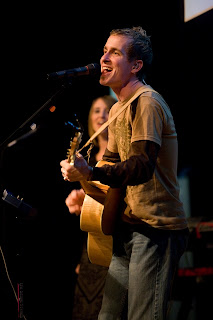 This was a good reminder to me that as we lead worship through music, we aren't leading only through what we sing, play, or say, we are also leading (and perhaps to an equal extent) through our expressions. Do we smile while we lead, or are we just straight faced? Does it look like we are enjoying praising our God, or do we just stand motionless with our feet glued to the floor and our eyes glued to our music?
I know for myself it's really easy to forget about this part. I get caught up in little distractions and forget that I need to be doing more than just playing the music right and singing my part right. I need to be fully involved in what we are saying and singing to God and listening for His response as well. If I keep my focus on God, where it should be, then it doesn't take any work at all for that to show through to other people. It can be anything from smiling, to clapping, raising my hands, closing my eyes, tapping (or stomping) to the beat, and the list could go on and on. Now, I'm not saying by any means that we should be forcing ourselves to do these things and fake that we are worshiping, nor am I saying that these things are necessary for someone to be able to worship. What I am saying is that when we do keep our focus on God while we are singing and playing, these physical expressions can be a natural way of showing what we are feeling in our hearts. And when others see these authentic expressions that overflow from our heart, it can help encourage them to worship also. So lets keep in mind that our physical expressions (even if it's as simple as smiling) can be as much a part of leading worship as playing and singing the music well. This ties nicely into Kauflin's reminder to us at the end of the chapter that on a Sunday morning we are not just a bunch of individuals seeking our own personal experience with God apart from everyone else, but instead we are His body corporately worshiping God together.
 This was a good reminder to me that as we lead worship through music, we aren't leading only through what we sing, play, or say, we are also leading (and perhaps to an equal extent) through our expressions. Do we smile while we lead, or are we just straight faced? Does it look like we are enjoying praising our God, or do we just stand motionless with our feet glued to the floor and our eyes glued to our music?
 I know for myself it's really easy to forget about this part. I get caught up in little distractions and forget that I need to be doing more than just playing the music right and singing my part right. I need to be fully involved in what we are saying and singing to God and listening for His response as well. If I keep my focus on God, where it should be, then it doesn't take any work at all for that to show through to other people. It can be anything from smiling, to clapping, raising my hands, closing my eyes, tapping (or stomping) to the beat, and the list could go on and on. Now, I'm not saying by any means that we should be forcing ourselves to do these things and fake that we are worshiping, nor am I saying that these things are necessary for someone to be able to worship. What I am saying is that when we do keep our focus on God while we are singing and playing, these physical expressions can be a natural way of showing what we are feeling in our hearts. And when others see these authentic expressions that overflow from our heart, it can help encourage them to worship also. So lets keep in mind that our physical expressions (even if it's as simple as smiling) can be as much a part of leading worship as playing and singing the music well. This ties nicely into Kauflin's reminder to us at the end of the chapter that on a Sunday morning we are not just a bunch of individuals seeking our own personal experience with God apart from everyone else, but instead we are His body corporately worshiping God together.
Monday, October 17, 2011
Chapter 13 - ...With Music...(Part 2: Planning Sunday's Songs)
 This chapter is all about planning the song set list (as well as other pieces that fit in or between songs) for a Sunday morning (or any event where we are gathered to worship through music). All of what Kauflin says in this chapter is really pretty straight forward and practical. Much of it what he has written in this chapter are the kind of things that are going through my head as I work on planning the music each week (though I still am learning new things about planning a service almost every week and I'm sure that I will have to be continually learning throughout the rest of my life).
 I know that this chapter is more directed at those who are actually planning a music set each week, but I hope that you will read it with the goal of gaining a better understanding of what we are after in a set for our Sunday morning services. Keeping some of these things in mind will also help each of us to make suggestions (yes, I am always open to suggestions) that are not just personal desires but that are based on improving the service as a whole and will help the congregation to meet with and bring glory to God.
Was there anything that was surprising to you in this chapter or that you hadn't considered before?
Tuesday, October 11, 2011
Chapter 12 ...With Music...(part 1: what kind)
Why do we use music in our worship of God? Well for starters God tells us to many times in His Word. The example that Kauflin gives is from Psalm 47. "Sing praises to God, sing praises! Sing praises to our King, sing praises!" God enjoys music that comes from His church that glorifies Him. On another level that Kauflin points out, "Music stirs up and expresses God-glorifying emotion." (p. 98) Music can be used to move our emotions. However, this is where we have to be careful. True worship cannot be simply an emotional experience.
As we've discussed before in previous chapters, truth has to be the center from which our worship flows. However, sometimes when we hear truth spoken over and over again, we tend to become somewhat cold to it and no longer respond to it the way we should. But when we add music to truth, it has a way of making the truth that we have become cold to suddenly become alive again as our emotions are moved by the music. These emotions can often help us to act on the truth that we are hearing and singing and cause us to move closer to God by doing so.
We have to be careful not to grow attached to just the emotional experience. Kauflin warns us against emotionalism. "Emotionalism pursues feelings as an end in themselves. It's wanting to feel something with no regard for how that feeling is produced or its ultimate purpose." (p. 99) There are many "worship" songs today that can really draw people into an emotional experience but that have very little truth in them, and sometimes even things that aren't true at all! That's when our "worship" can become ineffective or even idolatrous. We must maintain our focus on the truth of God (which comes from God's Word) and then allow our emotional experiences to enhance that truth in our lives. Glorifying God and moving into a closer relationship with Him is the goal. Music that stirs emotions is simply a tool that can help us along the way and is not the end in itself.
"Vibrant singing enables us to combine truth about God seamlessly with a passion for God. Doctrine and devotion. Mind and heart." (p. 99)
There are many other great points in this chapter but I'm a little short on time and want to just briefly mention one other very practical area that Kauflin talks about in reference to the arrangement of the worship team. "Most...musicians think that being up front means you should always be playing. WRONG. Varying when we play, how loudly we play, and what we play affects how people hear the words. The larger the team of musicans [this includes vocalists] the more each member should be listening to and making room for what others are doing." (p. 102)
This is such an important piece of being a part of any musical group and especially a worship team. We always need to be thinking of how we can make the song as a whole better. Often times that means not playing or singing and leaving space for other instruments or voices in a section of a song or even an entire song. When I'm recording and mixing a song I try to think about it like this: Every part (instrument or voice) that I add takes away a little bit of how well I can hear each of the other parts already in the song, so if I'm adding a part it needs to be something that is helping or adding to the song as a whole. If it isn't adding to the sound of the song as a whole then I shouldn't add that part. This can take a lot of time and practice to learn (I'm certainly still working on this myself and probably will be for the rest of my life) but it is an extremely valuable ability and each of us should be working on our listening ear to see what we can add to each song as a whole by either playing and singing or not playing and singing at any given moment.
I really liked the idea of one of Kauflin's closing thoughts. "As I understand it, the best music [for worship] enables people to genuinely and consistently magnify the greatness of the Savior in their hearts, minds, and wills." (p. 106) This is what we as worship leaders in our church need to be striving to bring to the congregation every week, music that "enables people to genuinely and consistently magnify the greatness of the Savior in their hearts, minds, and wills".
As we've discussed before in previous chapters, truth has to be the center from which our worship flows. However, sometimes when we hear truth spoken over and over again, we tend to become somewhat cold to it and no longer respond to it the way we should. But when we add music to truth, it has a way of making the truth that we have become cold to suddenly become alive again as our emotions are moved by the music. These emotions can often help us to act on the truth that we are hearing and singing and cause us to move closer to God by doing so.
We have to be careful not to grow attached to just the emotional experience. Kauflin warns us against emotionalism. "Emotionalism pursues feelings as an end in themselves. It's wanting to feel something with no regard for how that feeling is produced or its ultimate purpose." (p. 99) There are many "worship" songs today that can really draw people into an emotional experience but that have very little truth in them, and sometimes even things that aren't true at all! That's when our "worship" can become ineffective or even idolatrous. We must maintain our focus on the truth of God (which comes from God's Word) and then allow our emotional experiences to enhance that truth in our lives. Glorifying God and moving into a closer relationship with Him is the goal. Music that stirs emotions is simply a tool that can help us along the way and is not the end in itself.
"Vibrant singing enables us to combine truth about God seamlessly with a passion for God. Doctrine and devotion. Mind and heart." (p. 99)
There are many other great points in this chapter but I'm a little short on time and want to just briefly mention one other very practical area that Kauflin talks about in reference to the arrangement of the worship team. "Most...musicians think that being up front means you should always be playing. WRONG. Varying when we play, how loudly we play, and what we play affects how people hear the words. The larger the team of musicans [this includes vocalists] the more each member should be listening to and making room for what others are doing." (p. 102)
This is such an important piece of being a part of any musical group and especially a worship team. We always need to be thinking of how we can make the song as a whole better. Often times that means not playing or singing and leaving space for other instruments or voices in a section of a song or even an entire song. When I'm recording and mixing a song I try to think about it like this: Every part (instrument or voice) that I add takes away a little bit of how well I can hear each of the other parts already in the song, so if I'm adding a part it needs to be something that is helping or adding to the song as a whole. If it isn't adding to the sound of the song as a whole then I shouldn't add that part. This can take a lot of time and practice to learn (I'm certainly still working on this myself and probably will be for the rest of my life) but it is an extremely valuable ability and each of us should be working on our listening ear to see what we can add to each song as a whole by either playing and singing or not playing and singing at any given moment.
I really liked the idea of one of Kauflin's closing thoughts. "As I understand it, the best music [for worship] enables people to genuinely and consistently magnify the greatness of the Savior in their hearts, minds, and wills." (p. 106) This is what we as worship leaders in our church need to be striving to bring to the congregation every week, music that "enables people to genuinely and consistently magnify the greatness of the Savior in their hearts, minds, and wills".
Monday, October 3, 2011
Chapter 11 - ...Skillfully Combining God's Word...
 Wow! This chapter has done a bit of bashing to me! Much of what Kauflin says in this chapter I already have known in my head and have even attempted and practiced at times, but it has made me realize how remiss I have been in my duty as the worship leader to bring direct Scripture and Scripture informed prayer to the music portion of our worship time.
One of the things that was a bit of a wake up call to me was when Kauflin was talking about reading Scripture between songs and says, "People should be aware that the words they hear aren't ours, but God's." (p. 95) The first thought that went through my mind after reading this was, "Why have I been depriving people from hearing the very words of God during our worship time?" I know that Jim always teaches out of God's Word and I know that many of our songs are direct reflections of God's Word (I always make an effort to choose songs that are Biblically accurate and true), but shouldn't there be a greater emphasis directly on His Word intermingled with the music portion of our worship? "True worship is always a response to God's Word." (p. 91) When we incorporate Scripture into our singing time it gives us something to respond to (and certainly songs can do this on their own by proclaiming Biblical truths, but sometimes it is good and necessary to include direct Scripture in order to make the connections between God's Word and the words that we are singing).
So to conclude this little confession time of mine I ask that you would help to remind me of our need to keep God's Word included in our worship times. I'm sure I'll keep it in the forefront of my mind for a while, but I know that as the weeks go by I'll have a tendency to forget and get distracted by other things. Also I would encourage each of you to let me know if there is a particular Scripture that has been speaking to you during any given week that you might be willing to share or have me share on a Saturday and Sunday that might help lead us into a song that week.
This is just a small bit of what God used to speak to me in this chapter. How has God moved your heart in this week's reading?
Monday, September 26, 2011
Chapter 10 - ...Through the Power of the Holy Spirit
Desperate dependence, eager expectation, and humble responsiveness. These three attitudes play such an important role as we try to worship through the Holy Spirit. How often, though, do these attitudes move from our head to our heart and finally to our actions? I've known in my head for a long time that I am supposed to be dependent, expectant, and responsive to the Spirit and I have often even said some of these words in prayers before services, but the problem is that I have often let them just become routine words of prayer rather than honest God seeking prayer. In the past I have prayed things like this, "God, let your Spirit move in power among your people this morning, let our eyes be opened to see You." Did I really expect anything to happen outside of the routine? Sadly, I often have not. Part of the problem though is that I didn't really know what I should be looking for.
"When people grasp something of God's glory, the Spirit is at work. When people are convicted of sin, the Spirit is at work. When people receive hope and strength in the midst of a trial, the Spirit is at work. The Spirit may also choose to demonstrate His presence through a prophetic impression, a healing, or a heightened awareness of His nearness." (p. 84)
These are some of the things that we can come praying for and expecting the Spirit to do. As Kauflin mentions, the Spirit moving doesn't mean there has to be some dramatic spectacle of healing. It could mean that, but I think the Spirit is more interested in changing people's lives and hearts then in putting on a show. When we are convicted through the words of a song or the message that is preached and are brought to repentance as we fall upon God's grace and mercy, the Spirit is there. When we are humbled by the sacrifice that Jesus made for us and we realize our own inadequacy apart from Christ, the Spirit is there. When we are filled with joy, awe, or wonder as we learn about and come to realize an aspect of God's greatness and character that we haven't seen before, The Spirit is there. When we are simply overwhelmed and brought to tears because of the love that the Father has shown us, the Spirit is there. This list could go on and on about the different ways that the Spirit shows Himself and works in our lives but these are some things that we can be looking for both in ourselves and in others.
Our job, as Kauflin has made clear in this chapter, is to be desperately dependent on the Spirit, to eagerly expect Him to work, and to Humbly respond to Him. How? "Prayer is one of the primary ways we show that we're desperately dependent on God." (p. 83) This isn't talking about simply saying "help us to do well, God" before we begin a service. This is talking about a lifestyle of prayer where we are communicating with God throughout our day, every day. In a sense this involves making the Spirit a part of ourselves, allowing Him to take control of our thoughts, our actions. It means submitting ourselves in every way to His leadership. I'll tell you right now, this is no easy task but it is an exciting and rewarding experience that can continue throughout our lifetime.
As we show our dependence through prayer we need to begin looking for the Spirit's movement. After all when we are expecting a package or something in the mail, what do we do? We look for it. We watch and see if the delivery truck is stopping at our house. We go out to the mailbox or post office and check our box to see if it has come yet. This is what we should do in regard to the Spirit as well, only much more so! Rather then waiting around for something random and spectacular to happen, let's start praying specifically in God's will and start looking for the answers.
Then when we are living a lifestyle of prayer and we're looking for answers we need to begin listening with a humbleness and readiness to respond to the Spirit's leading. Humility comes into play as we realize that we are no longer in control of our lives, but that we have handed control over to God. We must not tear the controls away from God when He asks us to do something uncomfortable, difficult, or even painful. Our self-serving nature has to be put aside. We have to humble ourselves and respond to His voice.
These are all things that I'm really wrestling with and working on in my own life and it can be very difficult at times. Reading through these chapters is a great help and writing out my thoughts on this blog is useful to focus and pinpoint the areas that I'm working on. How is the Spirit working in your life? What has He shown you this week? Are you moving towards a greater dependence on, expectancy of, and responsiveness to the Spirit? Take some time each day this week to specifically pray and talk about these things with God. Try to begin a lifestyle of prayer, if you haven't already, by focusing on being aware of the Spirit's presence and leading no matter where you are.
"When people grasp something of God's glory, the Spirit is at work. When people are convicted of sin, the Spirit is at work. When people receive hope and strength in the midst of a trial, the Spirit is at work. The Spirit may also choose to demonstrate His presence through a prophetic impression, a healing, or a heightened awareness of His nearness." (p. 84)
These are some of the things that we can come praying for and expecting the Spirit to do. As Kauflin mentions, the Spirit moving doesn't mean there has to be some dramatic spectacle of healing. It could mean that, but I think the Spirit is more interested in changing people's lives and hearts then in putting on a show. When we are convicted through the words of a song or the message that is preached and are brought to repentance as we fall upon God's grace and mercy, the Spirit is there. When we are humbled by the sacrifice that Jesus made for us and we realize our own inadequacy apart from Christ, the Spirit is there. When we are filled with joy, awe, or wonder as we learn about and come to realize an aspect of God's greatness and character that we haven't seen before, The Spirit is there. When we are simply overwhelmed and brought to tears because of the love that the Father has shown us, the Spirit is there. This list could go on and on about the different ways that the Spirit shows Himself and works in our lives but these are some things that we can be looking for both in ourselves and in others.
Our job, as Kauflin has made clear in this chapter, is to be desperately dependent on the Spirit, to eagerly expect Him to work, and to Humbly respond to Him. How? "Prayer is one of the primary ways we show that we're desperately dependent on God." (p. 83) This isn't talking about simply saying "help us to do well, God" before we begin a service. This is talking about a lifestyle of prayer where we are communicating with God throughout our day, every day. In a sense this involves making the Spirit a part of ourselves, allowing Him to take control of our thoughts, our actions. It means submitting ourselves in every way to His leadership. I'll tell you right now, this is no easy task but it is an exciting and rewarding experience that can continue throughout our lifetime.
As we show our dependence through prayer we need to begin looking for the Spirit's movement. After all when we are expecting a package or something in the mail, what do we do? We look for it. We watch and see if the delivery truck is stopping at our house. We go out to the mailbox or post office and check our box to see if it has come yet. This is what we should do in regard to the Spirit as well, only much more so! Rather then waiting around for something random and spectacular to happen, let's start praying specifically in God's will and start looking for the answers.
Then when we are living a lifestyle of prayer and we're looking for answers we need to begin listening with a humbleness and readiness to respond to the Spirit's leading. Humility comes into play as we realize that we are no longer in control of our lives, but that we have handed control over to God. We must not tear the controls away from God when He asks us to do something uncomfortable, difficult, or even painful. Our self-serving nature has to be put aside. We have to humble ourselves and respond to His voice.
These are all things that I'm really wrestling with and working on in my own life and it can be very difficult at times. Reading through these chapters is a great help and writing out my thoughts on this blog is useful to focus and pinpoint the areas that I'm working on. How is the Spirit working in your life? What has He shown you this week? Are you moving towards a greater dependence on, expectancy of, and responsiveness to the Spirit? Take some time each day this week to specifically pray and talk about these things with God. Try to begin a lifestyle of prayer, if you haven't already, by focusing on being aware of the Spirit's presence and leading no matter where you are.
Monday, September 19, 2011
Chapter 9 - ...In Jesus Christ...
"Most people haven't spent much time considering their need for a mediator in their relationship with God. That's because we underestimate the gravity and offensiveness of our sin in light of God's infinite majesty, holiness, and justice." (p. 71)
 It's very easy to forget that we don't get to have a direct connection with God the Father. Our relationship with Him is only through the mediation of Jesus Christ. I think Kauflin is absolutely right that we tend to "underestimate the gravity and offensiveness of our sin" to God. I know for myself I can get into the "I'm not as bad as that person is" kind of thinking and I start subconsciously (or sometimes not so subconsciously) elevating myself thinking that I am better than others or that I have some kind of higher standing than other people do. This pride issue is something that many of us fall captive to without even realizing it, but Kauflin gives us a good reminder that every one of us, because of our sin, is completely offensive to God regardless of how much better we might think we are than someone else. It is only through the sacrifice and mediation of Jesus Christ that we can be presented to God in a way that is acceptable to Him and it is only through Jesus that we can present our worship to God in an acceptable way.
"We need to remember that our access to God is not based on last week's performance, today's practices, or tomorrow's potential. Rather, we're accepted 'in the Beloved' (Ephesians 1:6) and need have no fear of rejection as we come before God's throne." (p. 74)
What a good reminder this is. I often get caught up in the idea that I need to try harder, achieve more, and be better in order to somehow win God's acceptance and approval, but there is nothing we can achieve or accomplish to win acceptance or approval from God. If we have accepted Jesus Christ as our Savior and Lord, then we are accepted by God based on what His Son has done, not on anything we have done or can do. We are called to be Jesus' disciples and to follow Him which definitely involves a lot of work and effort, but it is not based upon that work and effort that we are acceptable to God. Jesus sacrifice was and is the only thing that God bases His approval and acceptance of us on. We can come to worship God boldly knowing that we are accepted not on the basis of our works but on the basis of Jesus Christ and Him crucified.
"All our offerings are humbled by the work of Christ because they would be unacceptable to God without Him. All our offerings are exalted because when they are joined to the atoning sacrifice of the Savior, God accepts them as though His own Son were offering them." (p. 75)
 It's very easy to forget that we don't get to have a direct connection with God the Father. Our relationship with Him is only through the mediation of Jesus Christ. I think Kauflin is absolutely right that we tend to "underestimate the gravity and offensiveness of our sin" to God. I know for myself I can get into the "I'm not as bad as that person is" kind of thinking and I start subconsciously (or sometimes not so subconsciously) elevating myself thinking that I am better than others or that I have some kind of higher standing than other people do. This pride issue is something that many of us fall captive to without even realizing it, but Kauflin gives us a good reminder that every one of us, because of our sin, is completely offensive to God regardless of how much better we might think we are than someone else. It is only through the sacrifice and mediation of Jesus Christ that we can be presented to God in a way that is acceptable to Him and it is only through Jesus that we can present our worship to God in an acceptable way.
"We need to remember that our access to God is not based on last week's performance, today's practices, or tomorrow's potential. Rather, we're accepted 'in the Beloved' (Ephesians 1:6) and need have no fear of rejection as we come before God's throne." (p. 74)
What a good reminder this is. I often get caught up in the idea that I need to try harder, achieve more, and be better in order to somehow win God's acceptance and approval, but there is nothing we can achieve or accomplish to win acceptance or approval from God. If we have accepted Jesus Christ as our Savior and Lord, then we are accepted by God based on what His Son has done, not on anything we have done or can do. We are called to be Jesus' disciples and to follow Him which definitely involves a lot of work and effort, but it is not based upon that work and effort that we are acceptable to God. Jesus sacrifice was and is the only thing that God bases His approval and acceptance of us on. We can come to worship God boldly knowing that we are accepted not on the basis of our works but on the basis of Jesus Christ and Him crucified.
"All our offerings are humbled by the work of Christ because they would be unacceptable to God without Him. All our offerings are exalted because when they are joined to the atoning sacrifice of the Savior, God accepts them as though His own Son were offering them." (p. 75)
Monday, September 12, 2011
Chapter 8 - Magnifying the Greatness of God
It seems that a lot of people today think that being a good worship leader means that you can magically usher in God's presence somehow, that you can make Him show up as if you could have some kind of control over what God does. But this is certainly not the case. God is already in any given worship service regardless of what the worship leader does or doesn't do. In fact He is everywhere.
Jeremiah 23:24 says,
"Who can hide in secret places
so that I cannot see them?”
declares the LORD.
“Do not I fill heaven and earth?”
declares the LORD.
If God fills the heavens and earth, then He's going to be there in our church services. Kauflin does a good job of bringing into perspective what it is that the worship leaders actually do. "Because we lose perspective so easily, God needs to become bigger in our eyes. He never changes in size--it just seems that way...Our great privilege as worship leaders is to help people see through the eyes of faith how great God has actually revealed himself to be. He doesn't change. We do." (p. 62) As we lead worship we aren't trying to usher God's presence into the building, or change God in anyway. He is there and He is mind blowingly amazing! Our job is to open our own eyes and help the congregation to open their eyes to see Him for who He really is and respond to Him appropriately by praising Him and magnifying Him. We (humans in general) have a tendency to forget very easily and so we have to continually redirect ourselves toward God and remember how great He really is so that we can worship Him appropriately.
I liked how Kauflin closed this chapter, it brings us right back to worshiping God with both knowledge and love--both must be present in our worship. "Magnifying God's greatness, then, involves proclamation and passion. Our responsibility as worship leaders is to make sure that in both ways--biblical truth and strong affections--people have every opportunity to magnify and encounter our great and awesome God." (p. 67)
What did God show you in this chapter?
Jeremiah 23:24 says,
"Who can hide in secret places
so that I cannot see them?”
declares the LORD.
“Do not I fill heaven and earth?”
declares the LORD.
If God fills the heavens and earth, then He's going to be there in our church services. Kauflin does a good job of bringing into perspective what it is that the worship leaders actually do. "Because we lose perspective so easily, God needs to become bigger in our eyes. He never changes in size--it just seems that way...Our great privilege as worship leaders is to help people see through the eyes of faith how great God has actually revealed himself to be. He doesn't change. We do." (p. 62) As we lead worship we aren't trying to usher God's presence into the building, or change God in anyway. He is there and He is mind blowingly amazing! Our job is to open our own eyes and help the congregation to open their eyes to see Him for who He really is and respond to Him appropriately by praising Him and magnifying Him. We (humans in general) have a tendency to forget very easily and so we have to continually redirect ourselves toward God and remember how great He really is so that we can worship Him appropriately.
I liked how Kauflin closed this chapter, it brings us right back to worshiping God with both knowledge and love--both must be present in our worship. "Magnifying God's greatness, then, involves proclamation and passion. Our responsibility as worship leaders is to make sure that in both ways--biblical truth and strong affections--people have every opportunity to magnify and encounter our great and awesome God." (p. 67)
What did God show you in this chapter?
Tuesday, September 6, 2011
Chapters 6 and 7
There was a lot of great stuff packed into these two little chapters this week. Here are a couple of things that stood out to me as I read.
"Music in the church is important. But is it more important than solid Biblical teaching that helps me grow in knowledge of God and obedience to His Word? In a word, no." (p. 52) A lot of times it seems that people (myself included at times) place more value on the quality of music rather than the quality of teaching at a church. People will often pass up a church that has a great Pastor because the music is only so, so or choose a church with great music even though the church's theology and doctrine is shaky at best. This thinking is so backward! Music is a means of worshiping God, but in order to worship Him correctly we must have good theology and doctrine first. If we have a poor, inaccurate, or even false understanding of God, who He is, and what He wants, we can't possibly expect to please Him with music even if it is excellently performed and the mix is just right. A right relationship with God must be the first priority, only then can our music be a means of worshiping God.
I like what Kauflin says about who a worship leader can be on p. 53. "Anyone who encourages others to praise God can be referred to as a 'worship leader'. Worship can involve music, but it can happen without it as well." As a worship team and as worship leaders we should think of ourselves as encouragers of the congregation as we help them to see the greatness of God and give Him praise.
There are so many other great points in these chapters, but I'm just going to jump to the end of chapter 7 and leave the rest for discussion in the comments. The last lines of this chapter we're a great encouragement and reminder to me and I hope they will be for you as well. "Ultimately, the fruit of faithful leadership is knowing we've pleased the audience of One. Our joy doesn't come from leading the perfect worship time, winning awards, or having a song on the worship charts. Our goal isn't success, popularity, or personal fulfillment. It's anticipating--by God's grace and fore the glory of Jesus Christ--that we'll hear on that last day, 'Well done, good and faithful servant.' (Matthew 25:21, 23). And that's a greater reward than anything this world could ever offer."
What encouraged you or challenged you in these chapters?
"Music in the church is important. But is it more important than solid Biblical teaching that helps me grow in knowledge of God and obedience to His Word? In a word, no." (p. 52) A lot of times it seems that people (myself included at times) place more value on the quality of music rather than the quality of teaching at a church. People will often pass up a church that has a great Pastor because the music is only so, so or choose a church with great music even though the church's theology and doctrine is shaky at best. This thinking is so backward! Music is a means of worshiping God, but in order to worship Him correctly we must have good theology and doctrine first. If we have a poor, inaccurate, or even false understanding of God, who He is, and what He wants, we can't possibly expect to please Him with music even if it is excellently performed and the mix is just right. A right relationship with God must be the first priority, only then can our music be a means of worshiping God.
I like what Kauflin says about who a worship leader can be on p. 53. "Anyone who encourages others to praise God can be referred to as a 'worship leader'. Worship can involve music, but it can happen without it as well." As a worship team and as worship leaders we should think of ourselves as encouragers of the congregation as we help them to see the greatness of God and give Him praise.
There are so many other great points in these chapters, but I'm just going to jump to the end of chapter 7 and leave the rest for discussion in the comments. The last lines of this chapter we're a great encouragement and reminder to me and I hope they will be for you as well. "Ultimately, the fruit of faithful leadership is knowing we've pleased the audience of One. Our joy doesn't come from leading the perfect worship time, winning awards, or having a song on the worship charts. Our goal isn't success, popularity, or personal fulfillment. It's anticipating--by God's grace and fore the glory of Jesus Christ--that we'll hear on that last day, 'Well done, good and faithful servant.' (Matthew 25:21, 23). And that's a greater reward than anything this world could ever offer."
What encouraged you or challenged you in these chapters?
Monday, August 29, 2011
Chapter 5 - Modeling Worship Everyday
"...leading worship starts with the way I live my life, not with what I do in public." (p. 43) In chapter five Kauflin talks about setting an example of worship in everyday life not only when we are seen publicly (like on Sunday morning) but in everything we do. This chapter was a really good reminder to me that the way I interact with God and others every day is more important to my ability to lead worship on a Sunday morning than the songs I've picked, the arrangement I've planned, or the mix of the music. People want to follow someone who is authentic and shows that they are a worshiper of God not only on Sunday morning but in all areas of their life.
"...set an example in speech, in conduct, in love, in faith, in purity." (1 Timothy 4:12) We (as leaders of worship) are responsible to set an example to others in all these areas at all times whether someone is looking or not. Obviously we aren't perfect and we rely on God's grace for the times that we sin but we need to always seek "to grow in [our] trust in God." (p. 47). I hope that we can all agree with Kauflin when he says, "I don't ever want people who see me lead worship publicly to be surprised by the way I live privately. It's not my songs that define my worship; it's my life." (p. 45) As a worship team our job is to do all that we can to help people encounter God. The best way for us to do that is to make sure that we our encountering God daily (through talking with Him or reading and studying His Word) so that He can help us to set an example in speech, conduct, love, faith, and purity. This point seems to come at me again and again, that I need to have time with God as the top priority of my day, every day. I found it encouraging though, to remember that perfection is not expected of us on our own. As Kauflin says, "The standard isn't sinless perfection. But there has to be a consistent lifestyle of Godliness." (p. 45) Only Jesus was perfect and it is only through His sacrifice that we can be made acceptable to God. Obedience can't win salvation for us but our obedience through modeling worship each day brings honor to God. We will be able to lead worship best when we are in that place of a consistent lifestyle of Godliness, while acknowledging our need for and dependance on Jesus Christ.
What moved you or stood out to you in this chapter?
"...set an example in speech, in conduct, in love, in faith, in purity." (1 Timothy 4:12) We (as leaders of worship) are responsible to set an example to others in all these areas at all times whether someone is looking or not. Obviously we aren't perfect and we rely on God's grace for the times that we sin but we need to always seek "to grow in [our] trust in God." (p. 47). I hope that we can all agree with Kauflin when he says, "I don't ever want people who see me lead worship publicly to be surprised by the way I live privately. It's not my songs that define my worship; it's my life." (p. 45) As a worship team our job is to do all that we can to help people encounter God. The best way for us to do that is to make sure that we our encountering God daily (through talking with Him or reading and studying His Word) so that He can help us to set an example in speech, conduct, love, faith, and purity. This point seems to come at me again and again, that I need to have time with God as the top priority of my day, every day. I found it encouraging though, to remember that perfection is not expected of us on our own. As Kauflin says, "The standard isn't sinless perfection. But there has to be a consistent lifestyle of Godliness." (p. 45) Only Jesus was perfect and it is only through His sacrifice that we can be made acceptable to God. Obedience can't win salvation for us but our obedience through modeling worship each day brings honor to God. We will be able to lead worship best when we are in that place of a consistent lifestyle of Godliness, while acknowledging our need for and dependance on Jesus Christ.
What moved you or stood out to you in this chapter?
Subscribe to:
Posts (Atom)